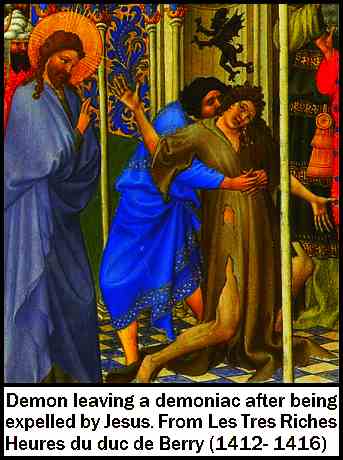
Demonic Possession
In ancient times many people believed that evil spirits can enter a person's body and take control of it. This was a common explanation for conditions such as epilepsy and madness. In modern terminology this "madness" probably referred to certain mental disorders such as schizophrenia and delirium. Even today, we still don't fully understand what causes these conditions. Ancient people, who had even less understanding, frequently put the blame on evil spirits.
These evil spirits were also called demons, devils, and unclean spirits. Anyone who came under their control was called a demoniac (or daimoniac), and the condition was known as "demonic possession".
In some ways demonic possession resembles multiple personality disorder. In this comparison, the demon acts like an evil alternate personality that has taken control of the mind. One difference is that an alternate personality usually doesn't take permanent control. But even when it isn't in control, it could still be lurking within the person's subconscious, and still might be able to influence behavior. Some people use this idea to try to blame their bad actions on an "inner demon".
The traditional cure for demonic possession is to expel the evil spirit from the victim's body. In ancient times this was known as driving out (or casting out) the demon. Many people now call it exorcism, and use the name exorcist for anyone who can successfully do it.
According to the gospels, Jesus often performed exorcisms along with his other miraculous healings. For instance, in describing his ministry in Galilee, Matthew 8:16 says:
When evening came, many who were demon-possessed were brought to him, and he drove out the spirits with a word and healed all the sick.
Sometimes a demon would try to talk to Jesus before it was expelled. For example, Mark 1:23-26 says that he was teaching to a some people in a synagogue when a possessed man suddenly cried out:
"What do you want with us, Jesus of Nazareth? Have you come to destroy us? I know who you are -- the Holy One of God."
"Be quiet!" Jesus said sternly. "Come out of him!" The evil spirit shook the man violently and came out of him with a shriek.
In this passage the voice of the man is actually the voice of the demon inside him controlling his breath and vocal chords. And because this demon is a spirit, it is able to recognize Jesus as "the Holy One of God." But Jesus tells it to "Be quiet" about this. At this stage of his ministry he was trying to keep his messiahship secret, and he didn't want the demon to reveal it publicly.
The demon also asks Jesus if he has come to "destroy us." When it says "us", it is referring to itself and all the other demons in the world. It is afraid that Jesus has come to destroy all of them. This idea is mentioned several times in the gospel of Mark, which depicts Jesus as waging a kind of war against demons. But since demons were regarded as agents of the Devil, this was actually a war between Jesus and Satan.
Modern Possessions
According to witnesses of modern exorcisms, the demon sometimes tries to hide within the victim, and hours may pass before it finally reveals itself. Then a prolonged struggle will often take place, with the victim shaking and jerking violently as the demon fights the spiritual powers invoked to expel it. During one reported struggle of this type, the victim's face suddenly contorted into an evil sneer that apparently emanated from the demon itself. Then a terrifying shriek pierced the air, and the body collapsed on the floor as the demon left it.
Some attempted exorcisms have had tragic endings. In these cases victims were tied down, then repeatedly choked, squeezed, beaten, and starved, sometimes over a period of several days, and this eventually caused them to die. Although these deaths were probably unintentional, several exorcists have been convicted of crimes and sent to prison.
Jesus never used physical force when he performed an exorcism. He simply ordered the demon to leave the body. They always obeyed him because they knew who he was, and recognized his power and authority.
Although most cases of possession involve a single evil spirit, it's possible for a person to be taken over by several spirits simultaneously. For example, Luke 8:2 says that seven demons were expelled from Mary Magdalene. In a modern case, a victim spoke in different voices which claimed to be the same demons that had previously possessed Judas Iscariot, Emperor Nero, Adolf Hitler, and several other well-known evildoers.
John 7:20 and 8:52 say that some people in Jerusalem even accused Jesus himself of being possessed by a demon. This may have been their explanation for his ability to perform miraculous cures. At that time there was a general belief that a possessed person could have unusual qualities such as superhuman strength, ability to see the future, or other special powers.
Unfortunately, Christians have sometimes accused other Christians of being possessed. This has happened during religious wars and persecutions, and during investigations into heresy and witchcraft. At the trial of Joan of Arc, church officials said that the voices in her head came from demons. In modern times accusations of demon possession have been made against members of certain fringe sects and against people who speak in tongues.
Evil spirits are sometimes blamed for other problems besides epilepsy and madness. For example, some people say that alcoholics, homosexuals, drug addicts, sexual predators, and adulterers are possessed by demons. Some Christians believe that a person who is filled with the Holy Spirit will be protected from the demons that cause these types of problems.
According to some ancient writings, demons were originally angels in heaven who supported the Devil in his rebellion against God, and were thrown out of heaven with him. Some sources say that one-third of the angels were thrown out in this way, and this has led to estimates that thousands, or even millions, of demons now serve Satan here on the earth.
But many people doubt that demons really exist. In their view, the possessed individuals described in the gospels were simply people who had mental illnesses. And Jesus cured them either through miracles or by using psychological techniques such as hypnosis.
Other Topics
Note: For more details on this topic, go to this Article about Demonic Possession
Contact Email