
If you search for images with Christian themes, you may come across the illustrations of Gustave Dore. This 19th-century French artist produced engraved drawings for more than 200 books, including Cervantes' Don Quixote, Balzac's Contes Drolatiques, Perrault's Fairy Tales, and Edgar Allan Poe's The Raven. Because of the dramatic impact of his macabre style, he was much in demand as a book and magazine illustrator throughout his adult life.
In 1864 an English book publisher hired Dore to create illustrations for a lavish new edition of the Bible, and these have become some of his best-known drawings. He also produced illustrations for editions of Dante's Divine Comedy, John Milton's Paradise Lost, and a book about the Crusades.
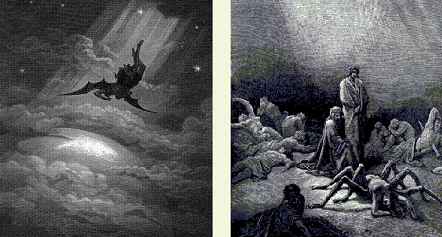
Most of his illustrations are now in the public domain, which means that anyone can freely use and distribute them. For this blog, I obtained the two images reproduced below courtesy of WikiMedia Commons.
The image on the left, from Milton's Paradise Lost, shows the Devil falling after being thrown out of Heaven. And the image on the right, from Dante's Divine Comedy, depicts a part of Purgatory.
I have used other Dore engravings to illustrate the article on Stigmata, the article on Hell, and an earlier blog post on Judas Iscariot.
Perhaps the best known modern attempt at an exorcism was performed on a young German woman named Anneliese Michel. Born in 1952 in the southern German state of Bavaria, Anneliese was very devout during her childhood, often sleeping on a bare floor in the belief that this would help pay for the sins of humanity. But when she was 16, she began to show signs of a serious psychological disorder that would later be ascribed to possession by demons. At this time she also began having convulsions that would render her unable to speak or call for help due to the feeling that a huge weight was sitting on her chest.
Shortly after the convulsions started, she began to see demonic images while praying. Then she began to hear voices in her head which told her that she was damned to hell. She also would sometimes act very strangely, exhibiting odd behaviors such as tearing off her clothes or eating spiders. A stay at a psychiatric hospital and the use of various prescription drugs didn't noticeably improve her condition. Eventually she began cutting herself with sharp instruments and then would try to bite her parents when they intervened. Sometimes she also refused to eat or drink, saying that the voices in her head told her that starving herself would help atone for the sins of modern wayward youth.
In 1975, when Anneliese was 23, a friend of the family suggested that her condition might be a case of demonic possession. An exorcist who lived in the area examined her and agreed that possession was a strong possibility. Soon afterward a bishop of the Catholic Church gave permission to perform an exorcism. (Some accounts say that Anneliese herself requested the exorcism.)
Two priests oversaw the rites of exorcism, which were repeatedly performed over a period of about ten months. Altogether there were sixty-seven sessions, each taking up to four hours. During the sessions Anneliese would frequently speak in voices which seemed to be coming from demons. Throughout this period she often refused to eat and became increasingly malnourished. Despite this, she would show almost superhuman strength during many of the sessions, so that three adult men could barely hold her down. To prevent resistance, she would sometimes be bound tied down with chains.
She died On July 1, 1976. An autopsy was performed, and the report listed the cause of death as malnutrition and dehydration. After an investigation, the state prosecutor concluded that medical intervention could have prevented the death, and charged four people, including her parents, with negligent manslaughter because they didn't bring in medical professionals to treat the eating disorder. After a highly-publicized trial, the defendants were declared guilty and sentenced to six months in prison and three years probation, although the six month prison sentences were later suspended.
In the article on the Nazarenes, I mentioned the modern communities of Nazarenes living in the Malabar region of India, who have a tradition that their original churches were established by the apostle Thomas in 52 AD.
Some intriguing evidence seems to support this tradition. First, in their own language these Malabar Christians call themselves Nasrani, and it is easy to see how this could be derived from the word "Nazarenes". Second, reports indicate that their version of Christianity includes some elements similar to those found in primitive Syriac Christianity. And third, independent European writings record stories about Saint Thomas leaving Palestine and traveling to India.
According to the Nasrani traditions, Thomas originally established seven churches in the Malabar region. It is thought that most of the new converts were Jews from communities of traders already living in the area. Unfortunately, no local written records survive from that period, so our knowledge of it depends on stories (and songs) that were passed down orally. But overall, I think the evidence in support of the Nazrani traditions about Saint Thomas is quite strong.
According to the bible, Jesus was crucified at a place called Golgotha. The gospels say that this name means "place of the skull", but there is much uncertainty about how the site got such a name. Here are the best-known theories:
1. The phrase "place of the skull" is a translation of the Aramaic word gulgulta, and refers to a landscape feature such as a hill or rock which had the shape of a skull.
2. The location was next to a cemetery, and the name refers to the skulls buried there.
3. The site was a place where public executions were held, and the name refers to abandoned skulls that would usually be lying around there.
4. The location was near the traditional burial site of Adam's skull.
5. The gospels are incorrect about the meaning of the name, and it actually derives from the Aramaic term Gol Goatha, which means "mount of execution".
Some of the best-known works of art in western civilization are depictions of people described in the bible. But because the bible doesn't give physical descriptions of many of these people, artists have often had to use their imaginations to try to match the physical appearance of a particular person with what the scriptures say about his or her character and behavior. A good example of this can be found in paintings of the infamous traitor Judas Iscariot.
In their depictions of Judas, nearly all artists have tried to show his fundamentally evil nature. Two of the most successful attempts are the painting The Kiss of Judas by Giotto di Bondone, and the engraving The Judas Kiss by Gustave Gore. Both depict the scene in which Judas kisses Jesus in order to identify him to the guards who have come to arrest him. Here are reproductions of the central portions of the two depictions:
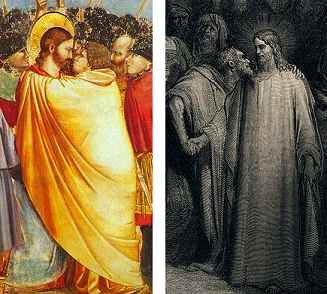
[Note that Dore's engraving (on the right) doesn't show an actual kiss]
What I find most interesting is that the two depictions of Judas are quite different, yet both of them clearly show his evil nature.
Some observers believe that occurrences of stigmata have become more numerous in recent decades. Whether this is true or not, it isn't uncommon to see news stories about modern examples of the phenomenon.
One well-known recent case, publicized in both a book and a television documentary, was that of an English woman named Heather Woods. Like many stigmatics, she apparently had a very difficult childhood, living in several foster homes and enduring sexual abuse, physical attacks, and psychological cruelty. As an adult, she gave birth to a brain-damaged baby and then was left to survive on her own when her husband died. Her sufferings caused her health to deteriorate, and this led to many illnesses, operations, and hospital stays.
At some point she began to go into trances during which she would see visions of Jesus. On one occasion she felt that she was inside his body as he hung on the cross. When she came out of the trance, she realized that blood was seeping from her palms. On later occasions she also had blood seep from her ankles and side.
Some other stigmatics have also reported that they had an experience of being crucified, and that it caused their stigmata.
Heather Woods isn't the only modern stigmatic whose story has been widely reported in the press. In fact the various media have done stories about many other cases, and a movie about the phenomenon has even been produced. But it isn't clear if this indicates that cases of stigmata are actually becoming more common, as some believe, or simply that modern media are more likely to report on the phenomenon.
Most reports of stigmata relate to people who are considered to be very pious and who have lived saintly lives. However, occasionally an irreligious person has also exhibited the wounds. Such "false stigmata" are sometimes attributed to the Devil.
Note: In the recent book The Other Christ: Padre Pio and 19th Century Italy, author Sergio Luzzatto charges that the well-known stigmatic Padre Pio faked his wounds by periodically applying carbolic acid to his skin. The Catholic Church, which canonized Padre Pio in 2002, has denied the accusation.
Jesus: The Evidence by Ian Wilson
This book is a careful examination of the basic evidence relating to the life and teachings of Jesus. It also discusses the different sides of the major issues and debates about him. A balanced objective readable account, suitable for both laypersons and scholars. Contains many interesting photographs. First published in 1984.
Who's Who in the Gospels by H. A. Guy
This is a small book, but it is packed with basic information on many subjects not covered in most other books. The topics are conveniently arranged alphabetically, and include not only the people mentioned in the gospels, but also places, events, and supernatural beings such as angels, demons, and the Devil. A very handy reference book, first published in 1966.
The Other Gospels: edited by Ron Cameron
This valuable anthology provides descriptions and translations of some early Christian works that aren't in the New Testament. Includes the Gospel of Thomas, the Apocryphon of James, the Gospel of Peter, and the Secret Gospel of Mark. First published in 1987.
Who Killed Jesus? by John Dominic Crossan
Biblical scholars have long debated the questions of why Jesus was crucified and who was responsible for the decision to kill him. In this book John Dominic Crossan, a leading scholar, argues that the Romans made the decision to kill Jesus because they saw him as a social agitator and trouble-maker, but that the gospel writers changed the story to put the blame on the Jews. First published in 1995.
The article on the Resurrection of the Dead Saints discusses a short passage at Matthew 27:52-53, which says that the bodies of some long-dead saints returned to life and left their tombs shortly after Jesus died on the cross. As the article points out, the other New Testament gospels don't mention these resurrected people at all, which is an indication that the author of Matthew may have had a unique source of information. Actually, most scholars think that the passage reflects a legendary story, not an actual event. But even so, the story must have originated somewhere.
In searching for the origin of the story, some scholars have focused on an even more mysterious passage, namely the "talking cross" episode in the apocryphal Gospel of Peter. This is part of the only known description of Jesus leaving the tomb after his resurrection.
According to the passage, the setting for his exit from the tomb is early on the first Easter morning, while it is still dark, as some Roman soldiers stand guard nearby. Suddenly they see two bright dazzling men descend from the sky and enter the tomb. A few moments later they come back out with Jesus between them, followed by a cross. The heads of the two men appear to reach to the sky, and Jesus looks even taller. Then suddenly a voice from heaven asks Jesus if he has preached to those who sleep, and the cross answers "yes".
Most people who read this passage envision a wooden cross which somehow follows Jesus and the two men out of the tomb. But not only can this cross move on its own, it can also talk, for it answers the voice from heaven. Most people are puzzled by the idea that a wooden cross can move and talk.
It's possible that this passage really does describe a wooden cross with supernatural powers. But some scholars argue for a completely different interpretation. They contend that the "cross" in this passage is actually a cross-like formation of resurrected saints, whose souls have returned from hell and brought their bodies back to life.
The basis for this alternate interpretation is the story of the Harrowing of Hell, in which Jesus descends to hell after his crucifixion and frees some souls from their imprisonment there. In some versions of this story, Jesus preaches to these souls before he frees them. This could explain why the voice from heaven in the Gospel of Peter asks Jesus if he has preached to those who sleep, since the bodies of the saints had been dead (asleep) while their souls were in still hell.
As already noted, the Gospel of Peter is the only gospel that describes the exit of Jesus from the tomb. Because this description includes several astonishing elements, such as dazzling men whose heads reach to the sky, and a voice from heaven, many scholars think that it is an imaginary story written by an unknown person who used Peter's name to try to publicize it. But a few scholars think that some of its elements could be based on real traditions. If so, those same traditions could have been the source for Matthew's passage about resurrected saints.
The Book of Revelation is probably the best-known description of what will happen during the End Times. But Jesus himself also made some predictions about this in a long speech found at Mark 13:3-37. In this passage, which is sometimes called the Little Apocalypse, he warns that a great catastrophe is coming to the world. He says that this catastrophe will include wars, earthquakes, famines, floods, and various other disasters. In Mark 13:24-25, he says:
"the sun will be darkened,
and the moon will not give its light;
the stars will fall from the sky,
and the heavenly bodies will be shaken."
During the period when Jesus was teaching, many people believed that these End Times were very near, or even already in their initial stage. In Matthew 3:7-10, John the Baptist talks of "the coming wrath", and urges people to repent before it is too late.
But Jesus apparently believed that the magnitude of the disaster could be reduced if people began to lead truly righteous lives. In Mark 13:20 he indicates that this could happen "for the sake of the elect." By these "elect", he meant the most devout and righteous people.
Near the end of his speech, in Mark 13:30, he says "I tell you the truth, this generation will certainly not pass away until all these things have happened." If he expected the catastrophe to come that soon, he must have urgently wanted to save as many people as possible. But according to Mark 13:27, he knew that only the most righteous people would survive. This could explain the urgency of his warnings and the stern morality of some of his teachings.
In his painting The Last Supper Leonardo da Vinci shows the beloved disciple sitting next to Jesus. Traditionally this mysterious disciple has been identified as Saint John the Apostle. But many people think that the figure in the painting looks like a woman rather than a man. And according to the authors of some best-selling books, Leonardo painted the figure this way because he knew of a secret tradition which indicated that the beloved disciple wasn't John at all, but was actually Mary Magdalene.
For those who want to judge the image for themselves, here is a reproduction of the whole painting followed by a closeup view of the portion which shows the beloved disciple. [Both images are courtesy of WikiMedia Commons. In the full painting the beloved disciple is sitting to the left of Jesus but leaning away from him and listening to some whispered words from Peter.
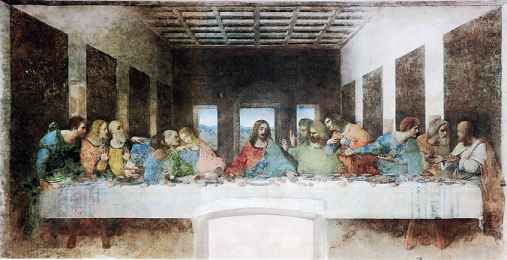
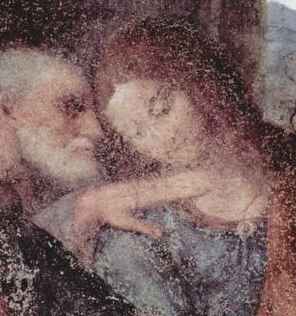
Unfortunately the original painting has badly deteriorated, and some of the fine details may have been lost. Nevertheless, it is easy to see why many people think that Leonardo either intended to depict a woman, or at least tried to subtly suggest that the figure could be a woman.
It wasn't unusual for Renaissance artists to try to put hidden clues or messages into their work. They did this to secretly express political or religious views which would likely get them punished if proclaimed openly. The church was a very powerful institution during Leonardo's lifetime, and Inquisitors still had the authority to torture and kill anyone who put forth heretical ideas. And the idea that Mary Magdalene was the Beloved Disciple would certainly have been considered heretical.
So was Leonardo trying to give a secret clue about her real role when he painted The Last Supper? You be the judge.
The Gospel Mysteries Blog provides a place for further discussion of the topics examined on the main website. In web directories it is usually listed in the Religion, Christianity, or Bible Blogs category.
