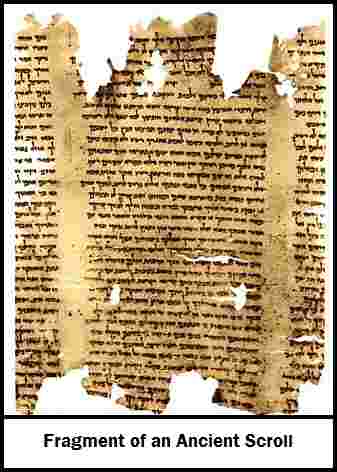
Lost Gospels
According to some estimates, early Christians wrote at least twenty gospels that weren't included in the bible. Many of these non-biblical gospels apparently disappeared later, although it's possible that copies of some of them still survive at unknown locations. Luckily, several that appeared to be missing have been found again in modern times. But some are still missing, and could be permanently lost.
Gospels that were left out of the Bible are called non-canonical gospels. Many scholars also call them apocryphal gospels, because most of them have unknown origins. This uncertainty about their origins was one reason many of them were excluded from the Bible. But some were also excluded because they expressed unorthodox or heretical views.
Scholars know about the past existence of some missing gospels because they are mentioned in other ancient writings that have survived. Parts of some lost gospels were even copied into surviving writings, so that a portion of their original content is still preserved.
In fact, people are often surprised to learn that parts of several lost gospels may have been preserved in Matthew, Mark, Luke, and John. This preserved material has been identified by certain characteristics which indicate that it was copied from other writings. Thus the authors of the New Testament gospels apparently got some of their information from earlier writings. Modern scholars call these earlier writings "sources", and have determined that there were probably three of them. But apparently all of them have disappeared.
These three lost sources may have been the first gospels. Their ancient names are unknown, so they are usually identified by modern names, specifically the Lost Q Source, the Pre-Markan Passion Narrative, and the Signs Gospel. Because no copies of any of them have survived, they are sometimes called hypothetical gospels. But most scholars believe that they really did exist at one time.
Actually, these three missing gospels aren't completely lost, since material from them is preserved in Matthew, Mark, Luke, and John. In fact, considerable knowledge about their original content has been obtained by studying this preserved material.
Some other non-biblical gospels have been discovered more directly, because actual physical remains have been found. Examples include the Gospel of Peter, the Gospel of Mary, and the Gospel of Judas. All of these were discovered in modern times. But only fragments or secondary translations have been found, so the complete original forms of all of them are still unavailable.
These three rediscovered gospels are named after Simon Peter, Mary Magdalene, and Judas Iscariot, but those weren't their real authors. Their real authors are unknown, and will probably never be identified. In ancient times anonymous authors would sometimes ascribe their books to famous people in an effort to get more publicity and authority for them.
Ancient writers mentioned a number of other gospels which they knew about, but which apparently no longer survive. These include the Gospel of Matthias, the Gospel of Perfection, the Gospel of the Seventy, the Dialogue of the Savior, the Gospel of the Twelve, the Gospel of the Hebrews, the Gospel of the Nazarenes, the Gospel of Bartholomew, the Secret Gospel of Mark, and the Gospel of Eve. Other gospels may have also existed, but even their names have been lost.
Some early gospels may have vanished because they were secret gospels and very few copies were made. Others could have been lost due to wars, conquests, upheavals, and persecutions. In addition, there have been accusations that early church leaders intentionally destroyed some gospels in order to cover up embarrassing facts about the origins of Christianity. Some intentional destruction did take place, but exactly what was lost can't be determined.
But the modern discoveries prove that a missing gospel can sometimes be found again. And there is a chance that more will be found in the future, especially since small fragments of several possible unknown gospels have been uncovered in various excavations.
Here are brief descriptions of some of the best-known lost (or rediscovered) gospels:
The Gospel of Mary
The existence of this gospel was unknown until several fragments were discovered in modern times. Since the only long fragment is a Coptic translation, most of the original Greek text is still lost. And even the long fragment may only include about half of the book.
Because the "Mary" in this gospel is depicted as a very prominent disciple, most scholars assume that she is Mary Magdalene, although in the extant text she is always just called Mary. The gospel emphasizes her prominence by presenting her as a strong leader, and by suggesting that she was the most favored disciple of Jesus and received a special revelation from him. It also suggests that this led to a conflict with Peter, who may have seen her as a threat to his position as overall leader of the disciples in the period after Jesus departed.
Indications of a rivalry with Peter are especially evident in the last section of the extant text, in which Mary gets into an argument with Peter and his brother Andrew over some private revelations that Jesus had given to her. This section may derive from memories of a historical conflict between her and Peter which eventually caused her to leave the group. Thus, although this gospel probably wasn't written until the second century, it may preserve some traditions passed down from an earlier period.
The Gospel of Mary contains some gnostic ideas, particularly in the section which describes the revelations she received from Jesus. This connection with gnosticism, together with the prominent role that the gospel gives to a female, may have led to its suppression by orthodox Christians.
The Gospel of Peter
A fragment of this gospel was discovered in Egypt in the late nineteenth century, and two more possible fragments have been found since then. But a large portion may still be missing. Hopefully the remainder will eventually be found, because the available text contains some interesting material, including the only known description of Jesus leaving the tomb after his resurrection.
Ever since the first fragment was discovered, this gospel has been controversial. A few scholars think that it preserves some of the beliefs and views of the earliest Christians. But most regard it as a secondary work containing a mixture of fanciful elements and material copied from the New Testament gospels.
One intriguing part of this gospel is its account of the exit of Jesus from the tomb. This exit takes place during the night as some Roman soldiers stand guard nearby. Suddenly the soldiers see two men (or angels) descend from heaven and enter the tomb. A short time later the men come back out with Jesus between them. At this point the men look so tall that their heads reach to the sky, and Jesus looks even taller. They are followed out of the tomb by a cross. Suddenly the soldiers hear a voice from heaven, and the cross answers it.
The description of this scene puzzles many people, since it appears to depict a wooden cross that can walk and talk. But some scholars think that the passage is actually describing a cross-like formation of resurrected saints who have returned to life along with Jesus and follow him out of the tomb. A few scholars also see connections between this account and a passage at Matthew 27:52-53, which describes a similar resurrection of dead saints.
The Gospel of Thomas
This gospel was probably first written in Greek, but the only surviving complete text is a Coptic translation discovered in Egypt in 1945. Its initial section indicates that it contains the "secret sayings" of Jesus, and the main text then gives 114 of these sayings. In most of the passages Jesus speaks as a teacher and his disciples make comments and ask questions.
Because the initial section of this gospel refers to "secret sayings", many scholars believe that it was a secret gospel, at least originally. This means that it was thought to contain secret knowledge, and that only certain individuals were allowed to read it. Several other secret gospels, or fragments of them, have also been discovered.
The Gospel of Thomas may preserve some authentic teachings of Jesus that aren't found in the bible. For this reason, many scholars regard it as the most important surviving non-canonical gospel.
The Gospel of Judas
The only extant copy of this gospel was found in Egypt, but the time and place of its discovery are uncertain, and there are indications that it passed through the Egyptian black market at one stage.
The existing copy is a Coptic text, probably a translation of a still-lost Greek original. Unfortunately the manuscript is damaged in many places, and some pages are missing, so that translation and interpretation are difficult. However, many scholars believe that it was a secret gospel used mostly by certain gnostic sects of Christians.
This gospel is notable in that it may depict Judas Iscariot as the most loyal disciple of Jesus, and an innocent martyr instead of an evil betrayer. But because of the damage to the manuscript, and the difficulties of interpretation, there is some uncertainty about this matter. In any case, this is one of the later gospels, probably not written until the second century, and most scholars doubt that it contains any authentic information about the real Judas Iscariot.
The Lost Q Source
This hypothetical gospel is also called the Lost Sayings Gospel and the Q Document. Like other hypothetical gospels, its probable existence has been inferred from studies of the New Testament gospels. In fact, it is thought to be the original source of many of the teachings of Jesus that are preserved in Matthew and Luke. The name "Q" comes from the German word "quelle", which means "source".
Most scholars believe that this gospel was primarily a collection of the sayings of Jesus, with little narrative material or biographical information. In the earliest period these sayings must have been preserved orally, but later someone apparently collected them and wrote them down. They may have been collected for the use of early Christian missionaries as an aid in spreading the new faith.
Scholars have put together possible reconstructions of this gospel by extracting material from Matthew and Luke, but some uncertainties are involved in exactly what should be included. There is a chance that some of the original parts of this gospel have been completely lost.
The Pre-Markan Passion Narrative
Scholars have deduced the probable existence of this hypothetical gospel from careful studies of the Gospel of Mark. These studies indicate that the author of Mark obtained some material from an earlier source. This source is now lost, but the evidence suggests that it was a short narrative of the arrest, interrogation, and crucifixion of Jesus. For this reason, it is called the Pre-Markan Passion Narrative (or Lost Passion Narrative).
The unknown author of this missing work had a good knowledge of what happened to Jesus during and after his arrest. It might have even been written by a member of the first community of believers, known as the Nazarenes, who lived in Jerusalem in the years after Jesus departed.
Reconstructions of the original form of this gospel indicate that it gave a simple straight-forward account of what happened before and during the crucifixion. Because this account may be the basis for all the later accounts, whoever wrote it performed an extremely important service.
The evidence suggests that the Pre-Markan Passion Narrative ended with either the burial of Jesus or the discovery of the empty tomb, so that it probably didn't describe any post-resurrection activities of Jesus.
The Lost Signs Gospel
The likely existence of this hypothetical gospel has been deduced from studies of the Gospel of John. It is called the Signs Gospel because it apparently described some miracles of Jesus which it called "signs". Its unknown author may have regarded the ability of Jesus to perform these miracles as one of the "signs" that he was the Messiah.
These miracles include the changing of water into wine (John 2:1-11), the giving of sight to the man born blind (John 9:1-8), the healing at the Pool of Bethesda (John 5:2-9) and the raising of Lazarus (John 11:1-45). The fact that these particular miracles aren't mentioned in the other gospels indicates that their authors probably hadn't seen the Signs Gospel.
In addition to the miracle stories, this gospel may have also contained some information about John the Baptist, and about the crucifixion and resurrection. But it probably didn't have much information about the teachings of Jesus.
Note: For more information about lost gospels, go to this article.
Other Topics
Contact Email