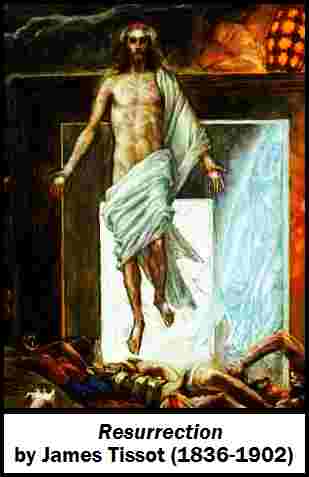
First Witness to the Resurrection
Who was the first person to see Jesus after his resurrection? To try to answer this question, we first need to look at what each gospel says about the matter.
Gospel of John (20:1-18)
This gospel gives the most detailed description of what happened on the morning of the resurrection. It says that Mary Magdalene went to the tomb shortly before dawn and saw that it was open. Thinking that someone had moved the body, she ran and told Peter and an unnamed disciple what she had seen. These two men ran to the tomb, found it empty, and then left the area. But Mary lingered nearby and began to weep. Eventually she looked into the tomb again and saw two angels, who asked her why she was weeping. She told them that someone had moved Jesus' body, and that she didn't know where it was. Then suddenly she turned and saw Jesus himself. Here is the description of her encounter with him, as told in John 20:14-16:
At this, she turned around and saw Jesus standing there, but she did not realize that it was Jesus. "Woman," he said, "why are you crying? Who is it you are looking for?"
Thinking he was the gardener, she said, "Sir, if you have carried him away, tell me where you have put him, and I will get him."
Jesus said to her, "Mary." She turned toward him and cried out in Aramaic, "Rabboni!" (which means Teacher).
Thus, according to this gospel, Mary Magdalene was the first person to see the risen Jesus. She didn't recognize him initially and thought he was a gardener. But when he spoke her name, she immediately knew who he was.
Gospel of Matthew (28:1-20)
This gospel also begins its account with the discovery of the empty tomb. But in this version of the story, Mary Magdalene is accompanied to the tomb by another woman who is identified as "the other Mary". After these two women reach the tomb, they see an angel who says that Jesus has risen and isn't there. The angel then instructs them to tell the male disciples that they can see Jesus in Galilee. The two women hurry off to find the male disciples, but on the way they suddenly encounter Jesus himself. He says, "Greetings", and they fall at his feet and worship him.
Thus, according to this account, Mary Magdalene and another woman also named Mary were the first eyewitnesses to the resurrection. This gospel doesn't describe any other encounters with Jesus in the vicinity of Jerusalem. But it says that the male disciples went to Galilee, (as the angel had instructed), and saw Jesus there.
Gospel of Luke (24:1-35)
According to this gospel, several women accompanied Mary Magdalene on her visit to the tomb, including Joanna and Mary the mother of James. After the women find the tomb empty, they suddenly see two men in shining garments standing next to them. These two men tell them that Jesus has risen and left. The women then go to the male disciples and tell them what happened at the tomb. The male disciples don't believe them, but Peter goes to the tomb anyway, finds it empty, and then leaves. Thus, according to this account, nobody saw Jesus during the initial visits to the tomb.
But later two of his followers do encounter him during a trip from Jerusalem to a village named Emmaus. One of these followers is named Cleopas, but the other one isn't identified. As they walk toward the village, Jesus joins them and begins talking with them, but they don't recognize him. After they reach the village, they all decide to have dinner together. During the meal the two travelers suddenly recognize their companion as Jesus, but he immediately vanishes from their sight. They then hurry back to Jerusalem to tell everyone what happened. When they arrive, they find the disciples gathered together talking, and saying that Jesus is alive and has appeared to Peter, though nothing is said about where or when this appearance to Peter took place.
Thus, this gospel isn't clear about who saw Jesus first. It could have been the two men who encountered him during the trip to the village, but initially didn't recognize him. Or it could have been Peter, who in the meantime had told the other disciples about an encounter of his own. In either case, this account is inconsistent with those of John and Matthew because it indicates that none of the women saw Jesus near the tomb.
Gospel of Mark (16:1-20)
The oldest known manuscripts of this gospel don't describe any post-resurrection appearances of Jesus. Partly for this reason, many scholars believe that this gospel's original ending has been lost. Whatever the case, these oldest manuscripts stop abruptly at verse 16:8, right after the discovery of the empty tomb. In the last two verses Mary Magdalene and two other women are told that Jesus has risen and is on his way to Galilee, and that his followers can see him there. Thus, if the original ending was lost, the missing part most likely described at least one appearance in Galilee but none in the vicinity of Jerusalem.
Later scribes who made copies of this gospel realized that the original ending may have been lost, and several new endings were eventually invented to take its place. The ending chosen for most modern bibles consists of twelve verses (Mark 16:9-20) known as the "Longer Ending" or "Apocryphal Addition". This ending says that the risen Jesus made his first appearance to Mary Magdalene. But this was probably copied from John's account and thus is unlikely to be an independent source of information.
The possible loss of Mark's original ending is especially unfortunate, because many scholars think that it was the first New Testament gospel to be written.
First Corinthians (15:1-8)
In addition to what the gospels say, there is also an important passage about the resurrection in Paul's first letter to the Corinthians. This passage (15:1-8) specifically says that the risen Jesus appeared first to Peter (who Paul calls Cephas), then to the other male disciples, and then to various other people.
Paul doesn't say where he got this information, but he did know Peter, and he also met some other disciples during his trips to Jerusalem. For this reason, and also because this letter to the Corinthians was probably written at least 15 years earlier than any of the gospels, some scholars think that it may be the most reliable source of information about the resurrection.